WPM to KPH Converter
Convert your typing speed from words per minute to keystrokes per hour. Enter your WPM to find the equivalent KPH, or switch direction to convert a KPH figure back to WPM.
Using five characters per standard typing word:
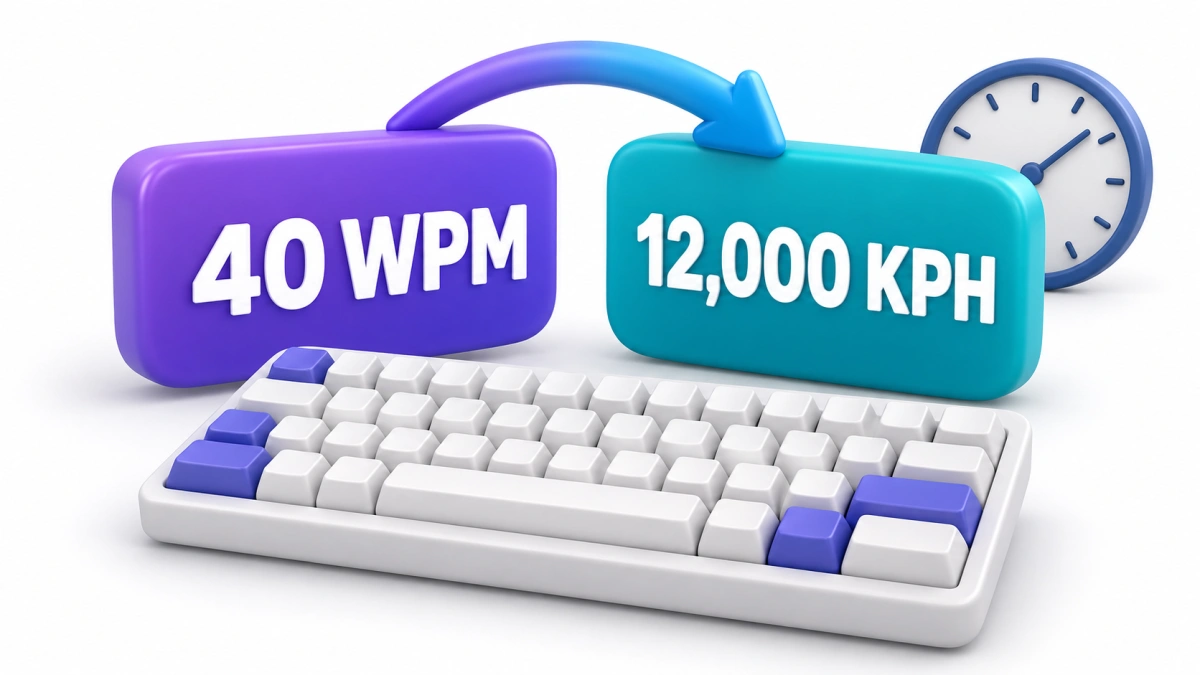
Based on five characters per word. This converts a rate; it does not measure a new typing attempt.
Not sure of your current speed? Take a typing test first, then convert your result.
How to Convert WPM to KPH
Multiply your words-per-minute figure by 300.
For example, if your typing speed is 45 WPM:
That is the hourly equivalent of the same rate, using the five-character convention.
You do not need to type for an hour to express a result in KPH. However, converting a short-test score does not establish that you can maintain that pace for a full hour.
Why multiply by 300?
The calculation combines two conversions:
- Words to characters: multiply WPM by five.
- Minutes to hours: multiply the resulting rate by 60.
Together:
Here is the same 45 WPM example in two steps:
| Step | Calculation | Result |
|---|---|---|
| Convert to characters per minute | 45 × 5 | 225 CPM |
| Convert to the hourly equivalent | 225 × 60 | 13,500 KPH |
The converter uses this counting convention. It does not count every physical keyboard action, such as pressing Shift or correcting text with Backspace.
For more about standard typing words, read what WPM means.
WPM to KPH Conversion Table
Find your WPM in the first column to see its equivalent in characters per minute and keystrokes per hour.
| Words per minute | Characters per minute | Keystrokes per hour |
|---|---|---|
| 10 WPM | 50 CPM | 3,000 KPH |
| 15 WPM | 75 CPM | 4,500 KPH |
| 20 WPM | 100 CPM | 6,000 KPH |
| 25 WPM | 125 CPM | 7,500 KPH |
| 30 WPM | 150 CPM | 9,000 KPH |
| 35 WPM | 175 CPM | 10,500 KPH |
| 40 WPM | 200 CPM | 12,000 KPH |
| 45 WPM | 225 CPM | 13,500 KPH |
| 50 WPM | 250 CPM | 15,000 KPH |
| 55 WPM | 275 CPM | 16,500 KPH |
| 60 WPM | 300 CPM | 18,000 KPH |
| 65 WPM | 325 CPM | 19,500 KPH |
| 70 WPM | 350 CPM | 21,000 KPH |
| 75 WPM | 375 CPM | 22,500 KPH |
| 80 WPM | 400 CPM | 24,000 KPH |
| 90 WPM | 450 CPM | 27,000 KPH |
| 100 WPM | 500 CPM | 30,000 KPH |
These are mathematical equivalents, not beginner, professional or hiring benchmarks.
For a value between the rows, use the converter. For example, 42.5 WPM × 300 = 12,750 KPH.
How to Convert KPH to WPM
To reverse the calculation, divide keystrokes per hour by 300.
Suppose a result shows 9,600 KPH:
The answer is the equivalent WPM under the same five-character convention.
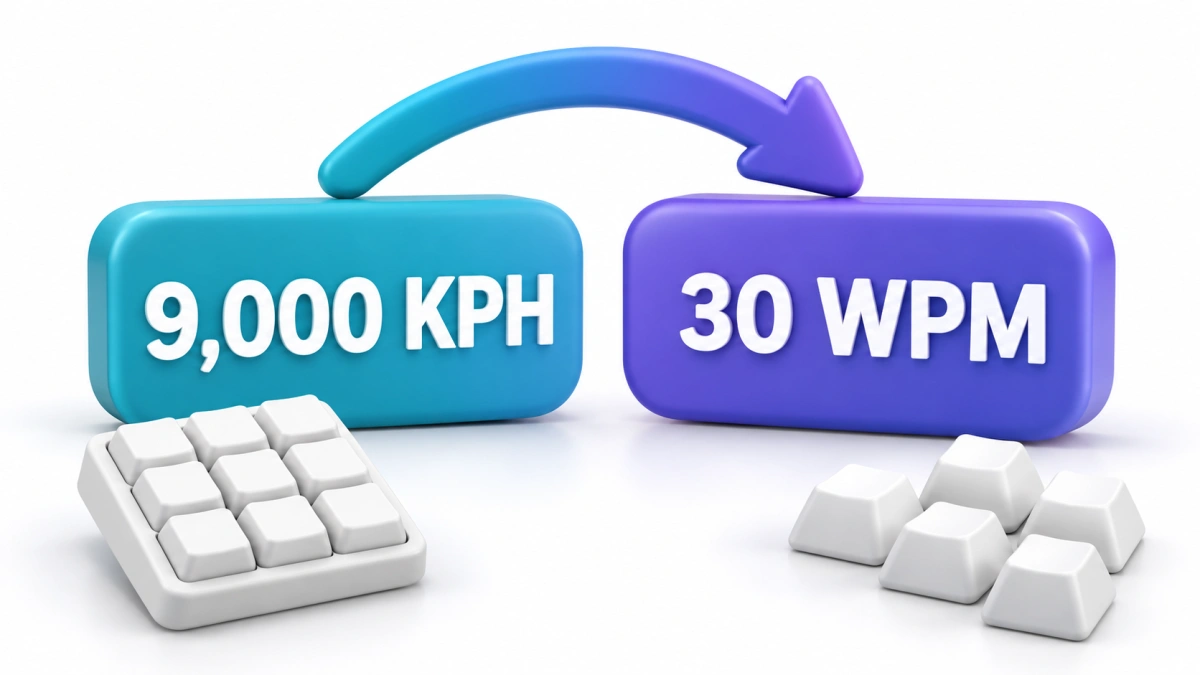
Common KPH values converted to WPM
| Keystrokes per hour | Calculation | Equivalent WPM |
|---|---|---|
| 4,500 KPH | 4,500 ÷ 300 | 15 |
| 6,000 KPH | 6,000 ÷ 300 | 20 |
| 8,000 KPH | 8,000 ÷ 300 | 26.67 |
| 9,000 KPH | 9,000 ÷ 300 | 30 |
| 10,000 KPH | 10,000 ÷ 300 | 33.33 |
| 12,000 KPH | 12,000 ÷ 300 | 40 |
| 15,000 KPH | 15,000 ÷ 300 | 50 |
| 18,000 KPH | 18,000 ÷ 300 | 60 |
Values such as 8,000 KPH do not convert to a whole number. Keep the decimal during calculation and round only the displayed answer.
Three Practical Conversion Examples
Example 1: Convert a typing-test result
Your test result is 52 WPM, and you want its hourly equivalent.
Record it as:
52 WPM — equivalent to 15,600 KPH using five characters per word.
Keep the original test duration and accuracy with the result. The conversion changes the unit, not the conditions under which you earned the score.
Example 2: Understand a KPH target
Suppose an exercise sets a target of 10,500 KPH.
That helps you understand the number in familiar WPM terms. It does not mean a 35 WPM paragraph score automatically satisfies the exercise: the text, numeric content and error rules may be different.
Example 3: Express an improvement in both units
Your comparable practice results rise from 38 WPM to 44 WPM.
| Result | WPM | Equivalent KPH |
|---|---|---|
| Earlier attempt | 38 | 11,400 |
| Later attempt | 44 | 13,200 |
| Difference | 6 | 1,800 |
Both columns describe the same change.
The KPH increase looks larger because its unit is smaller and its time interval is longer. It is not an additional improvement on top of the six-WPM increase.
WPM, CPM and KPH Measure Different Units
These labels can make one typing rate look like three different results.
| Unit | Stands for | What the figure expresses |
|---|---|---|
| WPM | Words per minute | Standard typing words entered per minute |
| CPM | Characters per minute | Counted characters entered per minute |
| KPH | Keystrokes per hour | An hourly keystroke rate under the stated counting rules |
For the conversion used here:
So 50 WPM, 250 CPM and 15,000 KPH are equivalent rates on this basis.
A direct keypress counter may use a different definition of a keystroke. Check the counting method before comparing its total with a character-based conversion.
If you have a character count and elapsed time rather than a speed score, use the WPM calculator first.
Does Converted KPH Tell You Your Data-Entry Speed?
It gives an equivalent rate, but it is not a substitute for measuring the task you need to perform.
Typing a paragraph and entering rows of numbers involve different movements. A data-entry task may require decimal points, separators, field changes or a numeric keypad. A paragraph test may contain none of those.
For example, 40 WPM converts to 12,000 KPH. That calculation alone cannot tell you how quickly you will enter invoice numbers or spreadsheet records.
Use the conversion to understand units. Use the relevant exercise to measure performance.
The 10-Key Typing Test and Number Typing Practice links already available on this page are useful next steps when your goal is numeric entry.
How Accuracy Affects the Comparison
Converting WPM to KPH does not remove mistakes or calculate accuracy.
If the number you enter is gross WPM, the output is its gross-rate equivalent. If the number is an adjusted WPM score, the converter scales that supplied score; it does not independently verify or reproduce the error adjustment.
Consider two hypothetical results:
| Attempt | Gross WPM | Converted KPH | Reported accuracy |
|---|---|---|---|
| A | 50 | 15,000 | 92% |
| B | 47 | 14,100 | 99% |
Attempt A has the higher gross rate. Attempt B has the higher accuracy. Converting them does not resolve that difference.
Keep the accuracy figure alongside the speed and check the original test’s scoring rules before calculating a net result. The typing accuracy guide explains why error counts need context.
Common Conversion Mistakes
Multiplying WPM by 60
Multiplying WPM by 60 gives standard words per hour, not keystrokes per hour.
For example:
To obtain the five-character keystroke equivalent, multiply by five as well:
Treating KPH as a total
A result of 12,000 KPH does not mean you entered 12,000 characters during a short test. It describes a rate.
At that rate, the equivalent amount over five minutes is:
Comparing different kinds of tests
A converted paragraph score and a measured numeric-entry score may use different tasks and counting rules. The same unit does not make those conditions identical.
Rounding too early
Keep the original value while calculating. If you round a WPM input before converting it, the KPH output will change too.
For example:
A value of exactly 10,000 KPH converts to a repeating decimal, approximately 33.33 WPM. A small difference after converting the displayed rounded value back is expected.
Questions About WPM and KPH
How many KPH is 40 WPM?
40 WPM equals 12,000 KPH using five characters per standard word: 40 × 300 = 12,000.
How many KPH is 60 WPM?
60 WPM equals 18,000 KPH on the same basis: 60 × 300 = 18,000.
What is 8,000 KPH in WPM?
8,000 KPH is approximately 26.67 WPM: 8,000 ÷ 300 = 26.666…
Is KPH the same as keystrokes per minute?
No. KPH is an hourly rate. Divide it by 60 to get the equivalent per-minute rate.
For example, 12,000 KPH ÷ 60 = 200 keystrokes per minute, using the same counting method.
Does this conversion include spaces?
The five-character WPM convention includes spaces and punctuation. This converter assumes the WPM input follows that convention; it does not inspect the original text.
Can I use a decimal WPM value?
Yes. For example:
There is no need to round your WPM to a whole number first.
Does the result prove I can maintain that speed for an hour?
No. It expresses your input as an hourly rate. Maintaining it for an hour would require a separate measurement over that period.
Convert a Score You Have Measured
Enter your existing typing score in the converter above, and keep the original duration and accuracy in your records.
If you need a fresh measurement, take a typing test. If you have only characters and time, start with the WPM calculator.